
You may have seen the headlines: “CERN Scientists Are Turning Lead into Gold!” It sounds like the fulfillment of a medieval alchemist’s dream, the kind of mythical transformation that obsessed scholars and mystics for centuries. Turning one element into another, especially something as common as lead into something as prized as gold, has long captured the human imagination. So, has modern science finally cracked the ancient code? Are we witnessing a scientific gold rush in the tunnels beneath Switzerland?
Not exactly. While the headlines aren’t entirely wrong, they miss the point of what actually happened at CERN’s Large Hadron Collider. This isn’t about wealth or wizardry, it’s about physics, and a very specific kind of nuclear reaction that’s as complex as it is awe-inspiring. The real story involves lead atoms, intense fields of energy, and transformations so small and fleeting they can only be seen with the world’s most advanced detectors. Let’s unpack what really happened, because the truth is even more fascinating than the fiction.
The Golden Claim
Scientists working with the ALICE experiment at CERN’s Large Hadron Collider (LHC) recently reported that, during high-energy collisions of lead nuclei, atoms of gold were produced. Technically speaking, this is true. But as always, science needs caveats.
This is not magic, not profitable, and not something you can scale up to create gold bars. What happened is an extraordinary example of nuclear physics at the most extreme frontier, and it tells us more about the universe than it does about economics.

What Really Happened?
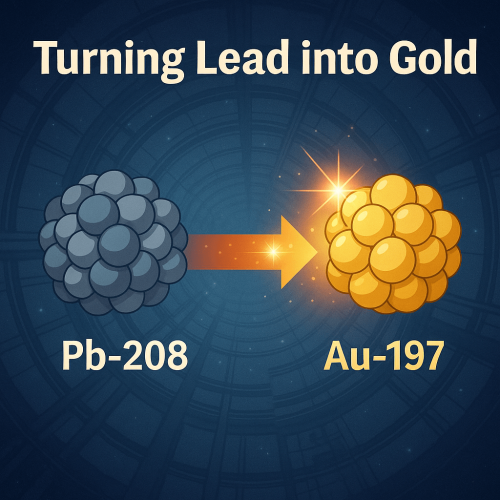
At the LHC, physicists collided lead nuclei (Pb-208) traveling near the speed of light. These were ultraperipheral collisions, meaning the nuclei barely grazed past each other. Instead of smashing together directly, they interacted through their electromagnetic fields, emitting powerful bursts of light—more precisely, virtual photons.
These photons were so energetic that they knocked protons and neutrons out of the lead nuclei. This process, called electromagnetic dissociation (EMD), led to some lead atoms losing up to three protons. Since the identity of an element depends on how many protons it has, these lead atoms effectively transformed into thallium (1 proton lost), mercury (2 protons lost), or gold (3 protons lost).
In other words, lead became gold by losing three protons.
Does This Mean We Can Manufacture Gold?
No. And here’s why:
- The gold atoms produced are microscopic, just a few per billion collisions.
- They are unstable isotopes, meaning they decay quickly and are not the kind you find in jewelry.
- Each collision uses astronomical energy and a huge machine stretching over 27 kilometers.
- The total amount of gold created during LHC Run 2 (2015–2018) is estimated to be less than 30 trillionths of a gram—far less than a grain of salt.
So while it is scientifically accurate to say lead turned into gold, it is not practical, not profitable, and not alchemy in the ancient sense. It’s a showcase of high-energy nuclear transformation, not a new method of wealth creation.
Why Is This Important Then?
Because it’s science at its most fundamental. These rare transformations help physicists:
- Understand how atomic nuclei behave under extreme conditions.
- Refine theoretical models.
- Improve collider design and safety, since such processes create nuclear byproducts that can degrade the LHC’s beam performance.
- Plan for future experiments like the Electron-Ion Collider (EIC) in the US, which will probe the structure of matter even more precisely.
Most interestingly, it shows us that nuclear transmutation (changing one element into another) is real. It is governed by quantum rules, not myth, and we now have the tools to observe it directly.
The Caveat Scientia Takeaway
Yes, lead can become gold. But that is not the real headline.
The real story is that the universe is full of forces capable of changing matter in remarkable ways, and we are finally able to observe and understand them. This is not the return of alchemy. It’s better. It’s physics!


